Number and Time
The following is an incomplete paragraph-by-paragraph summary of Marie-Louise Von Franz’s Number and Time. I have only published the first chapter, but I hope to return with the others at a later date.
In the black is Marie-Louise Von Franz’s (MLVF) claims. ← In blue are my own thoughts and responses.
Chapter 1
We may state a few connections between psyche and matter, though their relationship remains a mystery.
Our personality consists of ego-centered consciousness and unconscious activities. We can gain indirect information about the latter through dreams, fantasies, involuntary gestures, and so on.
The collective unconscious appears to have a similar structure in every human being and is the “living creative matrix of all our conscious and unconscious functioning.”
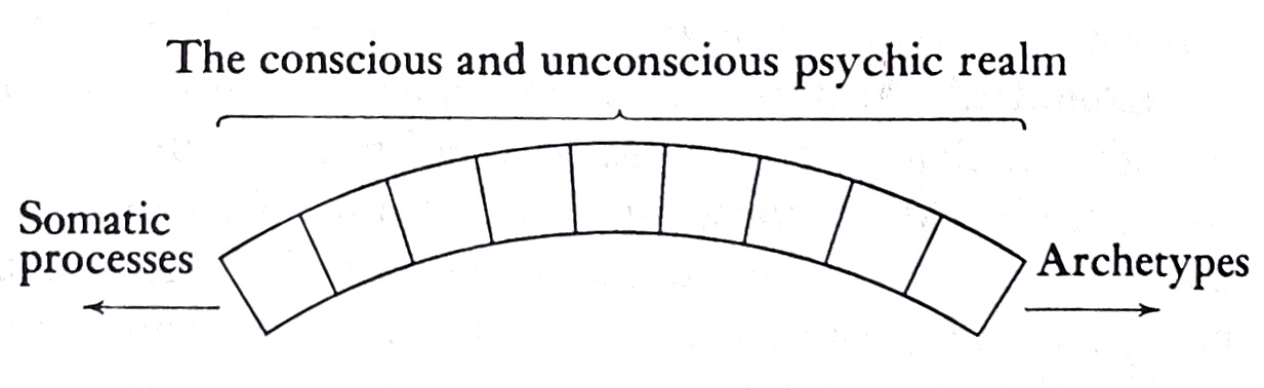
The psyche is a spectrum-like field of reality situated between the “infrared” pole of the material bodily reactions and the “ultraviolet” pole of the archetypes (see image above).
The ego awareness can be drawn in either direction. If one is overcome by an instinctive occurrence, then one will be attracted to the left-hand somatic pole. If one is “possessed” by an idea, one is more attracted to the right-hand archetypal pole.
Hypothesis: The two poles exist within the same unknown living reality, and are only interpreted as distinct within our consciousness. There are many parallels between the thought models of psychics and psyche. E.g., the necessity for taking the “observer” into account when observing events; the limitation of only being able to describe the “workings” (or phenomena) of nonperceptual structures (or noumena).
The connection between psyche and matter is demonstrable in the case of psychosomatic illness (where the psyche influences the material), and in that dreams (among other psychic occurrences) are influenced by physical events (here, the material influences the psyche).
Synchronicity consists of a symbolic image constellated in the psychic inner world (in a dream, for instance) which coincides (in a manner not casual or rationally explicable) with an event of similar meaning in the outer world.
When the archetypal realm is “activated,” psychophysical events occur frequently enough that they cannot be dismissed as “pure chance.” ← This is the key claim. A lot rests on the term “activate,” and this seems to be a claim that can only really be tested or understood by living through it oneself. One could defer to those who have lived through it themselves and have helped interpret the experiences of many, many others (Jung, MLVF, etc.). But this reliance significantly limits understanding.
Jung uses the term “unus mundus” to describe the unity of psyche and matter. This is distinct from Eric Neumann’s “oneness of reality”, which refers to the merging of the individual with his actual physical surroundings.
The idea of unus mundus relies on the idea of an underlying numinous from which all phenomena (psychic and material) emerge. ← Tomberg wrote that this underlying unity (which is not directly available to perception) is what is meant by the Logos or the Word in his essay titled “The Hermet” (see the section on the synthesis of the antinomy of idealism and realism).
On this matter, Jung put forth (but did not show beyond doubt) two important hypotheses: (1) that synchronicity, though in practice a relatively rare phenomenon, is an all-pervading factor or principle in the universe (i.e., in the unus mundus, where there is no incommensurability between so-called matter and so-called psyche). And (2) that the number was a key to this mystery, as they are just as much discovered (emerging externally) as invented (emerging internally).
Wang Fuzhi wrote that existence is based on an all-containing continuum which is itself lawfully ordered but which, in itself, is without perceptual manifestation. The 64 images of the I Ching participate in the all-containing ordered continuum (i.e., Logos) and can be understood numerically (but also directly, emotionally, or experientially). Number is then a possible entry point to understand the situations represented by these images.
Note: The “all-containing continuum which is itself lawfully ordered but which, in itself, is without perceptual manifestation” perfectly synthesizes what I already understood of both the Noumenon (without perceptual manifestation) and the Word or Logos (lawfully ordered all-containing continuum). It appears to me, then, that Noumenon and Logos point to the same underlying reality but emphasize its different aspects (imperceptibility and orderedness, respectively). Going forward, I will use these terms interchangeably.
Both the quantitative (numbered) and qualitative (direct, emotional, or experiential) approaches aim to comprehend the psychophysical background of existence.
The I Ching implicitly posits (a) that archetypal images not only flow from the all-containing continuum (a.k.a Noumenon, a.k.a Logos) and (b) that this flow takes place in a certain order and sequence.
Synchronous events then enter time (both subjectively and objectively) from eternity (or the Logos), and to understand these events is the aim of the I Ching.
Jung posited that acausal events (synchronicity) might be only a special instance of acausal orderedness. Acausal orderedness of certain natural phenomena may be observed in matter (e.g., in the discontinuities in physics such as radioactive decay) as well as the psyche (e.g., in the just-so uniformity of associations to natural integer concepts). ← Supposedly, (a) radioactive decay occurs in sudden, unpredictable jumps rather than in a continuous flow, revealing a kind of acausal “break” in physical processes, and (b) quantum events like these unfold without a deterministic cause. I don’t know anything about these subjects personally and am not in a position to pass judgment on these claims. In the psyche, MLVF refers to the striking consistency across cultures and eras where the number 1 tends to signify unity, 2 duality, 3 emergence or mediation, 4 completeness, and so on.
Instances of acausal orderedness have always existed and occur regularly, while synchronicities are acts of creation in time. The latter should be understood as the eternal presence of the single creative act.
Number is an archetype and thus a constituent of nature, both within and without.