Right-Wing and Left-Wing Truths
I once studied Leo Strauss’ The City and Man in a university setting. At one point, the class laughed at the idea of equality as the highest political ideal. The joke was lost on me at first, but I understood they were suggesting it contains an internal contradiction. The contradiction is this: equality is relational, not aspirational. It is a manner of relating to one another (horizontally), not a prescription for what that interrelated group should be working toward (vertically). Ideal implies verticality. Consider the Aristotelian ideal for political life: living well together. Equality as an ideal would address living together, but not address what it means to live well. One could easily imagine an “equal” society where everyone is miserable and suffering meaninglessly—clearly this is not the ideal! This insight leads to the most important “right-wing” claim. In two parts: (1) political life should aim at an ideal. And (2) true hierarchy forms naturally based on nearness to that ideal.
Still, we must not forget equality! The “right-wing” claim presents only half the picture. Returning to the Aristotlelian example, a city that forgets interrelatedness (e.g., love of one’s neighbor) in pursuit of an ideal will aim only at living well and not living well together. This distinction is addressed with human rights. Rather than material equality (i.e., equity or equality of outcome), human rights establish equality on the level of freedoms or choices. These undeniable freedoms, albeit repeated ad nauseam, are the proper (more subtle) place for equality. In this manner, each individual can choose his or her speech, religion, and vote for the leader of his or her choice. Each individual is presumed innocent until proven guilty and has a right to a fair trial. Each individual can also bear arms, provided he or she does not use it to deprive the rights or freedoms of another. In their fullest form, laws based in human rights free the individual from any unchosen responsibilities. This is the most important “left-wing” claim. That is, one should place the utmost value on the absence of coercion, and use force only to stop one citizen from infringing upon the rights of another. An attentive reader may notice that we have derived Isaiah Berlin’s positive and negative freedoms as the primary “right-wing” and “left-wing” values. We may also bridge the divide between right and left by recognizing that both are not only necessary but also good.
The embodied synthesis of positive and negative freedom is found in loving encouragement (i.e., agape) toward the ideal without coercion.
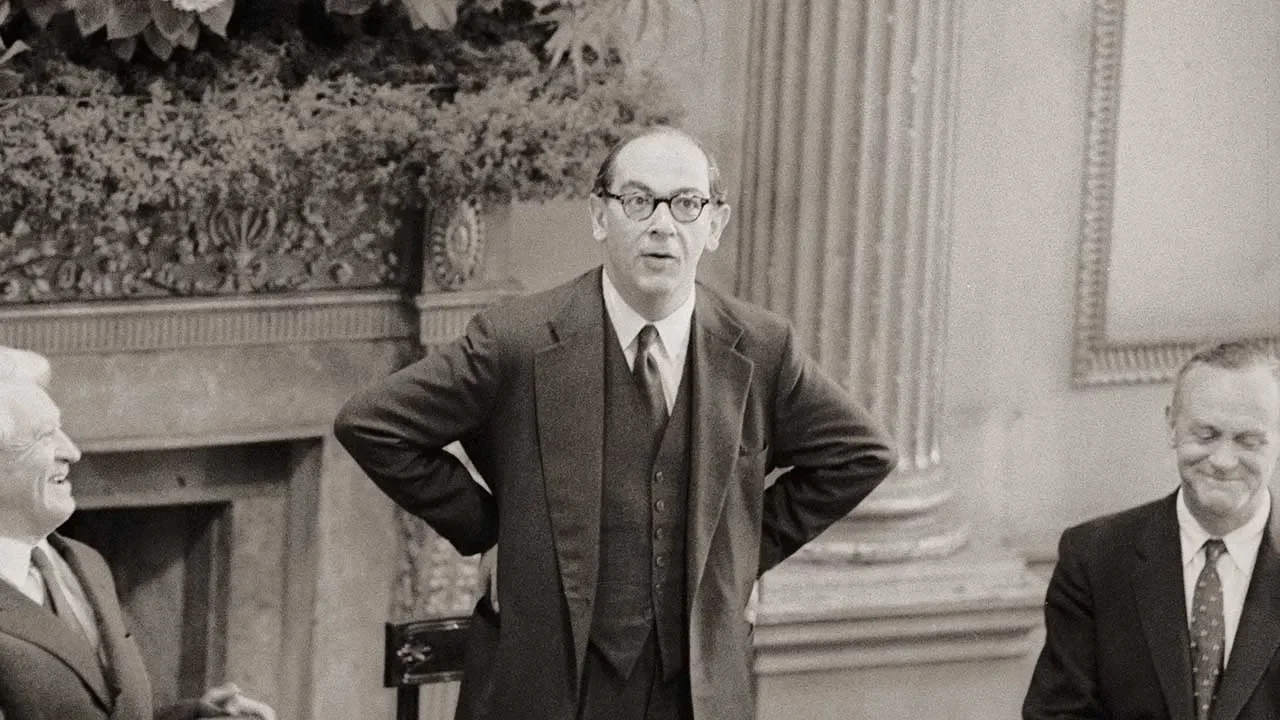
Isiah Berlin